
Is SEO Dead in 2026? What AI Search Really Means for Businesses

 xt-admin
Companies have mainly used SEO to show up in Google results, draw organic traffic, and get leads for many years. However, changes are happening faster than before. New formats like AI Overviews, AI Mode, ChatGPT, Perplexity, Gemini, and other AI-powered search are changing people’s behaviors: they get information, compare companies, and make purchase decisions through these AI formats.
So, is SEO dead in 2026?
No. SEO is not dead. It is evolving.
Although it is very common to associate SEO with digital marketing, it should not be forgotten that traditional SEO is still the bedrock of being found, visible and popular online. On the other hand, newer techniques like AEO (Answer Engine Optimization), GEO (Generative Engine Engine Optimization), AIO (AI Optimization) and LLMO (Large Language Model Optimization), are opening businesses up to new ways of achieving visibility through search.
At this time, the marketing world in general is talking about these approaches as different strategies for reaching people that can be stacked on one another rather than replacing one entirely.
The businesses that adapt will not abandon SEO. Instead, they will build a broader AI search optimization strategy around it.
Why Are People Asking, “Is SEO Dead in 2026?”
The traditional search journey was relatively straightforward:
Search → Click a result → Visit a website → Take action
AI-powered search can change that journey:
Ask a question → Receive an AI-generated answer → Explore cited sources → Compare options → Take action
Google’s AI search experiences and independent AI platforms can provide summarized answers instead of requiring users to browse multiple traditional search results. This means businesses now need to think beyond rankings and focus on whether their content can be understood, extracted, cited, and trusted by AI systems.
That does not make traditional SEO irrelevant. It makes search visibility broader.
SEO Is Still the Foundation
One of the biggest misconceptions about AI search is that businesses can simply stop doing SEO.
That is a mistake.
Technical SEO, useful content, internal links, crawlability, page experience, structured data, topical authority, and relevant backlinks are ways which can lead websites to the top.
AI search does not eliminate the importance of having a strong digital foundation. Instead, AEO and GEO build on many of the same fundamentals that successful SEO already requires.
What Traditional SEO Still Does
SEO helps businesses:
- Improve organic search visibility
- Make websites easier to crawl and index
- Target relevant search intent
- Build topical authority
- Earn organic traffic
- Strengthen website credibility
- Support local search visibility
- Create a foundation for AI-driven discovery
The goal is no longer simply to rank for a keyword.
The bigger goal is to become a trusted source of information wherever your customers search.
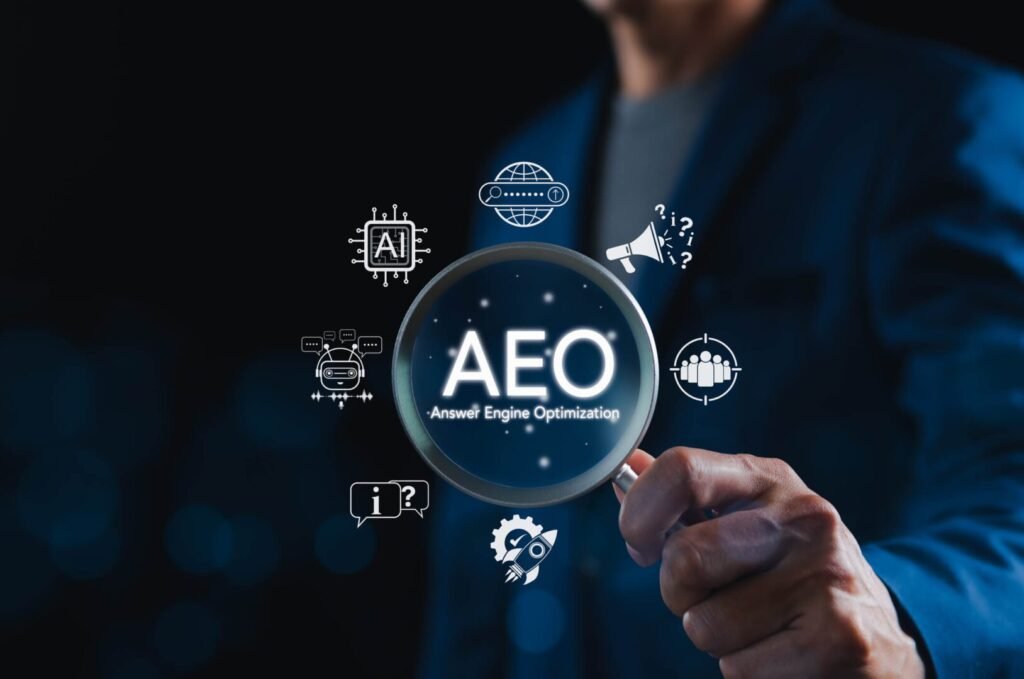
What Is AEO?
AEO stands for Answer Engine Optimization. The idea is to craft content that is more readily digestible and utilizable by answer engines and AI search systems when they have to give out answers.
Instead of asking only:
“How do I rank this page?”
AEO asks:
“How can my content become the answer?”
This means content should provide clear, direct answers to real customer questions.
AEO Strategies Businesses Can Use
A strong AEO strategy can include:
- Question-based headings
- Concise answers near the beginning of sections
- FAQ content
- Structured content
- Clear definitions
- Supporting statistics and evidence
- Schema markup where appropriate
- Strong author and business information
- Content that directly matches search intent
For example, instead of creating a generic page about “web hosting,” an AEO-focused article could answer:
- What is web hosting?
- How much does web hosting cost?
- What type of hosting is best for a small business?
- How does web hosting affect website speed?
This makes the content easier for both users and search systems to understand.
What Is GEO?
GEO, or Generative Engine Optimization, focuses on improving a brand’s visibility in generative AI experiences.
The objective is not simply to rank a webpage. It is to increase the likelihood that AI systems can find, understand, and accurately represent information about a business.
GEO is particularly relevant to platforms and experiences such as ChatGPT, Gemini, Perplexity, and AI-powered search environments.
What Is AIO?
AIO, or AI Optimization, is a broader term that can describe efforts to improve how AI systems understand, interpret, and represent a business.
Rather than focusing on one search engine, AIO can take a wider view of AI visibility.
This can include:
- Brand entity optimization
- Consistent business information
- Knowledge graph signals
- Structured data
- Content quality
- Reputation signals
- Cross-platform consistency
- AI visibility monitoring
- Accurate descriptions of products and services
AIO should not necessarily be treated as a completely separate replacement for SEO. In practice, it can function as an umbrella strategy that brings multiple AI-search optimization activities together.
SEO vs. AEO vs. GEO vs. AIO
| Strategy | Main Focus | Primary Goal |
| SEO | Traditional search | Improve rankings and organic visibility |
| AEO | Answers and questions | Become a direct, useful answer |
| GEO | Generative search | Increase AI citations and brand mentions |
| AIO | Broad AI visibility | Help AI systems understand and represent your brand |
| LLMO | Large language models | Improve how your content and brand are understood by LLM-based systems |
These strategies overlap significantly. The exact terminology also varies across the industry, so businesses should focus more on the underlying visibility goals than on collecting acronyms.
How Businesses Can Prepare for AI Search
The answer to “Is SEO Dead in 2026?” should not be to abandon your current SEO strategy.
Instead, expand it.
- Build a Strong SEO Foundation
- Create Answer-Focused Content
- Build Topic Clusters
- Strengthen Your Brand Entity
- Earn Third-Party Mentions
- Optimize for Local Search
- Measure More Than Rankings
What About LLMO?
Large Language Model Optimization, or LLMO, is another phrase that comes up in AI search conversations.
The goal is to make brand information understandable to massive language model-powered systems in a clear, consistent, and authoritative manner.
This reinforces an important principle:
Your business needs to be understandable, not just rankable.
That means publishing accurate information about:
- Who you are
- What you offer
- Who you serve
- Where you operate
- What makes your expertise different
- Frequently asked questions
- Products and services
- Industry knowledge
SEO isn’t dead. Search is evolving.
The businesses which thrive in 2026 and afterward are those that will focus their efforts on making their websites as credible, useful, recognizable, and easy to understand for users and search engines rather than on ranking manipulation.
Suppose your current marketing strategy only revolves around keywords and rankings, then now you must start incorporating AEO, GEO, AIO, entity optimization, structured content, topical authority, and other advanced search engine methods into your strategy.
Frequently Asked Questions
Company Portfolio