
Top Features Users Expect From Mobile App Development in 2026
 xt-admin
In 2026, users want apps that are intuitive, quick, safe, personalized, and multipurpose. To meet customers’ expectations and increase retention, a business should invest in developing a mobile app with AI personalization, biometrics, convenient payments, smart notifications, accessibility, and other features. A professional mobile app development company can assist in creating the most suitable app for a business and its target audience.
Why User Expectations Matter in Mobile App Development
A mobile application is much more than just a computer program for businesses. It is a way to connect directly with the audience. People want to use apps to simplify their lives. They want to do everything from shop to manage their money to make doctor’s appointments.
If an application is too slow or has a difficult interface, the user will simply go to a competing app. With this in mind it is important to have native mobile apps that are developed with the end user in mind, not the developer or company that made it.
For companies that are interested in St. Louis mobile app development and want to provide the best possible experience to the customer, it is vital to focus on usability, performance, security, and overall practicality.
9 Essential Features Users Expect From Mobile Apps in 2026
1. Fast Loading Speeds and Smooth Performance
Users are expecting applications to load quickly on their mobile devices, especially when a screen is opened, an item is searched, or a purchase is made. Poor performance can damage the customer experience and undermine the confidence of the customer in an application.
A good development process should emphasize the following optimization areas:
- Handling of poor or no network connection state
- Optimized images, scripts, and application resources
- Fast API calls and data processing
- Quick screen transitions and response to user interaction
- Good performance on all supported devices
2. AI-Driven Personalization
Artificial intelligence (AI) is giving rise to innovative ways to personalize mobile phone apps. Rather than showing every user the same content, these apps are able to tailor their offerings to individual users according to the preferences and behaviors of each user.
Use cases may include:
- Offering product recommendations based on browsing and purchasing history.
- Personalized content and services suggestions.
- AI-driven searches and chatbots.
- Reminders based on users’ preferences.
- Automated responses to frequently asked questions.
Firms should adopt AI-driven personalization when it has a genuine business need. Personalization should always be done in a way that respects user privacy and provides clear value to the user in terms of how their data is being used.
3. Strong Security and Biometric Authentication
Security is a top priority, especially for web applications handling personal data, conducting financial transactions, processing bookings, or storing business critical information.
Modern users expect convenience in terms of multifactor authentication without sacrificing account security.
Some essential security features that could be supported by the back-end and implemented in the front-end at the design stage include:
Biometric verification (for devices and browsers supporting such technology).
- Secure log-in and recovery procedures.
- Multi-factor authentication and strong passwords.
- Data encryption during transit and at rest.
- Secure session structure and privilege management.
- Periodic penetration testing and software audits.
A professional mobile app development company should design secure software by default and not as an afterthought.
4. Simple and Intuitive User Interface
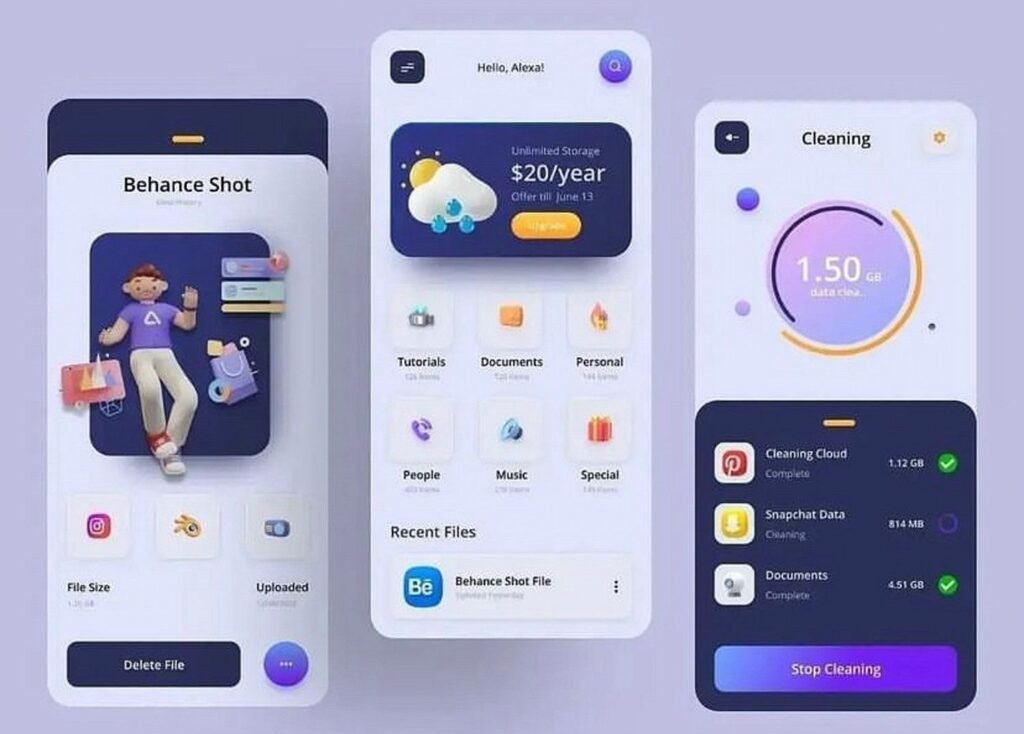
Users should be able to understand an app without spending time learning how it works. Clear navigation, readable text, consistent layouts, and recognizable controls help people complete tasks confidently.
An effective interface should provide:
- Design Principles for User Interface
- Easy-to-find menus and common functions.
- The same buttons, icons, and layout throughout the application.
- Clear error messages, hints, and instructions.
- High contrast colors and standard fonts.
- Onboarding process that is simple and quick.
For instance, a service booking application should have an option to choose a service and a convenient time for an appointment without additional hassle.
5. Personalized Push Notifications
Push notifications can notify end-users of relevant information such as order status, reminders of upcoming appointments, delivery progress, and other critical account updates.
However, irrelevant push notifications are a fast way to irritate and alienate your user-base and turn off all notifications from your application.
The following tips will help create a personalized push notification strategy and engage customers without annoying them:
- User-initiated notification preferences.
- Relevance and timeliness of notifications.
- Contextual information and value in notifications.
- Limitation of notifications’ frequency.
- Deep-linking to specific areas within the application.
In doing so, it is important not to overwhelm the users by getting too eager to send push notifications and messages but instead provide quality information that the users will want to receive.
6. Seamless and Secure Payment Options
For e-commerce, subscription, booking, and service-based applications, convenient payment methods can be a deciding factor in whether a user finalizes their purchase.
Based on the company’s business model and the target market, the following features should be considered:
- Digital wallets and mobile payment options.
- Card payments (credit/debit).
- Secure payment gateway.
- Transparent pricing, taxes, and summary of transactions.
- Receipts and confirmation of payments.
- Refunds and tracking of payments.
The company should consider what features are relevant to its customers and region and invest in secure and reliable services that meet local regulations.
7. Cross-Platform Compatibility
Businesses can access their applications using android phones, iPhones, tablets, and other devices. Therefore, companies must consider how to approach the target audience considering the technologies they use.
It is possible to choose between developing native software and using cross-platform tools. The former can guarantee higher performance and additional features, whereas the latter allows reducing mobile app costs and maintaining the same code for iOS and Android.
This decision depends on the company’s requirements, such as necessary functions, budget, target audience, maintenance needs, and others. An experienced mobile app development company can help create the most efficient solution and analyze the incoming demands.
8. Real-Time Updates and In-App Communication
Many applications are reliant on timing information. Users want to know if the order has been dispatched, the driver is approaching, the appointment has been rescheduled and the support request has been addressed.
Capabilities such as
- Live order and delivery tracking,
- Appointment and booking updates,
- In-app messaging when appropriate,
- Real-time collaboration or synchronization
- Alerts for important changes.
Real-time features should be implemented according to actual business requirements, since not every application needs live tracking or instant messaging.
9. Accessibility and Inclusive Design
A mobile application should work for everyone. Users should be able to interact with the software regardless of their personal circumstances, such as being disabled or not tech-savvy. One should also consider application accessibility on various devices, browsers, and operating systems.
The following factors should be taken into account:
- Using screen-reader-friendly platform;
- Appropriate color contrast;
- Easy-to-read fonts;
- Large touch targets;
- Avoiding gestures;
- Providing captions and alternative text;
The principles of inclusive design should be integrated during development rather than waiting for the product launch.
Why Work With a Mobile App Development Company in St. Louis?
Businesses searching for St. Louis mobile app development solutions should look for companies that specialize in this field. To ensure quality work, businesses must understand the importance of a systematic procedure for developing mobile applications.
Companies looking for mobile application developers in St. Louis should ask the following questions:
Experience: Ask for their previous work, expertise, and experience in the mobile application development field.
User-centered design: Ask how they conduct research and prototyping to understand the end-users’ preferences.
Technical expertise: Determine their knowledge about platforms, tools, third-party APIs, and other relevant aspects.
Security: Ask how the company handles sensitive data and testing procedures for applications.
Communication: Ensure that there are no ambiguities about the timelines and progress of the project.
Maintenance and support: Find out how the company plans to handle post-launch activities and updates.
Build a Better Mobile App for Your Customers
In 2026, the key to a successful mobile app lies in an enhanced customer experience. The importance of apps with AI-driven personalization, biometric verification, accessibility compliance, frictionless payments, and optimized performance makes creating an engaging digital product more critical than ever.
A mobile app development company has to carefully consider what features to include in the app and which ones can wait. The most valuable features are usually those that directly address the customers’ requests.
By focusing on the specific needs of the target audience and carefully planning the app’s evolution, companies can create a digital product that will be relevant for years to come.
If you want to develop a mobile app that will meet the requirements of modern users, contact our team to discuss the possibilities and find the most viable solutions for your business.
Frequently Asked Questions
Company Portfolio